
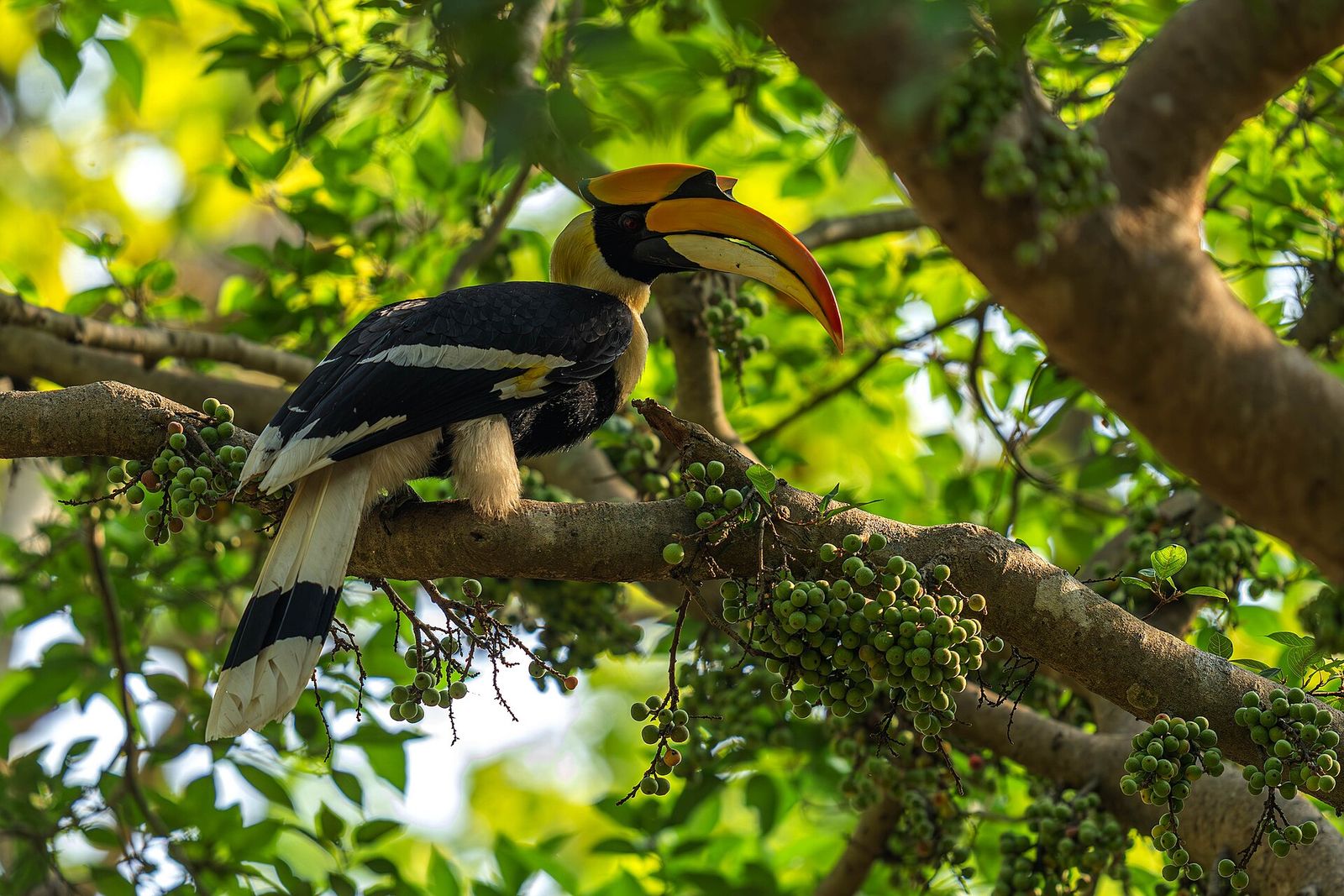
From hunters to nest protectors: the hornbills of Pakke
In Arunachal Pradesh, members of the Nyishi community who once hunted hornbills now guard their nests.
Hornbills are among the most striking birds of the Eastern Himalaya, and for the Nyishi people of Arunachal Pradesh they have long had cultural significance. The upper beak of the great hornbill, in particular, was used in traditional headgear, and the birds were also hunted for food. As forests were cleared and hunting continued, hornbill numbers in parts of the region fell.
The Nature Conservation Foundation, an Indian conservation non-profit, describes on its website a programme it began in partnership with the Ghora-Aabhe Society and the Arunachal Pradesh Forest Department in 2011–12, in the Papum Reserve Forest next to Pakke Tiger Reserve. In the Hornbill Nest Adoption Programme, citizens, in India and abroad, adopt a nest by paying a yearly fee, and local people from the Nyishi community are employed as nest protectors who monitor and guard the nest trees. The foundation describes this as a shared-parenting model, and notes that several of the nest protectors were once hunters.
Reporting by The Better India, a Bengaluru-based news site, and others quotes the forest officer in charge of Pakke saying hornbill numbers there rose by around 20 to 25 per cent after the programme began, while noting that there is no official census. Outcomes have not been formally measured, so these figures should be read as an indication rather than as a proven count.
For visitors, the lesson is practical. Pakke is a protected area with forest rules, and bird-watching is best done with a licensed local guide. If you want to support the work, adopting a nest through the foundation is one route; another is to stay with a locally run lodge and choose a guide from the community.
Nobody here is on show. Guides, protectors and village families are people with their own lives and decisions, so ask before photographing and respect rules at nest sites.
Prices, dates, permits and rules change — approximate, verify before you travel. Researched from public sources; field verification pending.
Planning a journey like this?
Tell us the season and your pace — we'll shape it into a private itinerary.
Talk to a travel designer