
Samarkand, Bukhara, Khiva: the Silk Road cities, slowly
Three UNESCO-listed old towns in Uzbekistan, a fast train between two of them, and a case for staying long enough to look at the tilework twice.
The Silk Road was never one road, and it was never only about silk. It was a web of caravan routes across Central Asia along which cloth, paper, metal, ideas and religions travelled, and the oasis cities of present-day Uzbekistan were its great switching points. Three of them are the usual first choice for a visitor: Samarkand, Bukhara and Khiva. Each has a historic core on UNESCO's World Heritage List, and each feels different enough that going to all three is worth the effort.
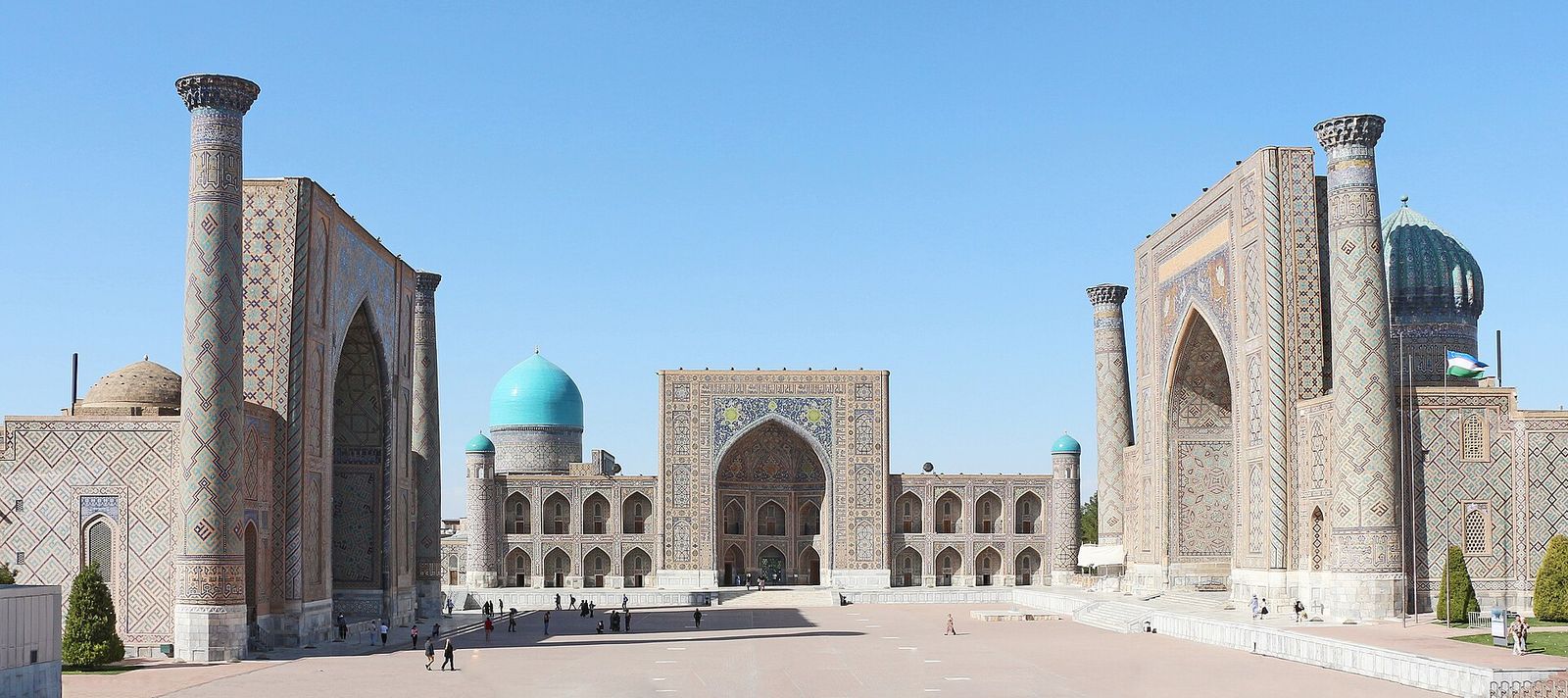
Start in Samarkand, whose historic core was inscribed in 2001. Its best-known square is the Registan, a name that classical Persian sources give as roughly “place of sand”. Three madrasas, or religious colleges, face one another across it. The Ulugh Beg madrasa was built between 1417 and 1420, the Sher-Dor between 1619 and 1636, and the Tilya-Kori between 1646 and 1660. The Sher-Dor takes its name from the tigers on its entrance arch, each with a sun rising on its back, an unusual image on an Islamic building. Plan to see the square more than once. In the middle of the day it is a crowd and a glare; at dawn or after dark, when the lights come on, you can read the patterns.
Bukhara, inscribed in 1993, is a different kind of city: more compact, more lived-in, and good to walk. Its historic centre holds about 140 monuments, according to a standard reference. The Kalyan minaret, an early-eleventh-century tower of around 45 metres, still anchors the skyline. The Samanid mausoleum, built in the late ninth and early tenth centuries, is admired for its brickwork, which turns plain baked brick into a woven-looking surface. Around the pool at Lyab-i Hauz, one of the few such ponds that survive, the old merchant city's habit of sitting down to talk is still easy to see. The Ark, the old rulers' citadel, was badly damaged in 1920; what you see is what remained.
Khiva, the far western stop, is the most compact of the three. Its walled inner town, Itchan Kala, was Uzbekistan's first World Heritage inscription, in 1990. The mud-brick walls rise eight to ten metres, and inside them the Juma mosque has a forest of 112 wooden columns, many of them taken from older buildings. Kalta Minor, a turquoise minaret that was never finished, is the most photographed object in town. Khiva is quiet in the early morning, before the tour groups arrive, and that is the hour to give it.
Getting around is easier than it was. An Afrosiyob high-speed train links Tashkent, Samarkand and Bukhara; published guides give roughly two hours from Tashkent to Samarkand and about an hour and a half from Samarkand to Bukhara, though timetables differ by train and season. Khiva sits further west and is usually reached by road or by an internal flight to Urgench. Allow at least two nights each in Samarkand and Bukhara, and one or two in Khiva.
A word on timing and entry. Spring and autumn are the commonly recommended seasons; the summers are very hot. Check before you book anything. Entry rules for Indian passport holders can change at short notice: check the official Uzbek e-visa portal and with your airline before you book.
How to go well: buy ceramics, silk and suzani embroidery from the people who make them, ask before photographing, and spend a morning in a craft workshop rather than another monument. The cities were built by traders and craftspeople, and they are best understood the same way.
Prices, dates, permits and rules change — approximate, verify before you travel. Researched from public sources; field verification pending.
Planning a journey like this?
Tell us the season and your pace — we'll shape it into a private itinerary.
Talk to a travel designer