
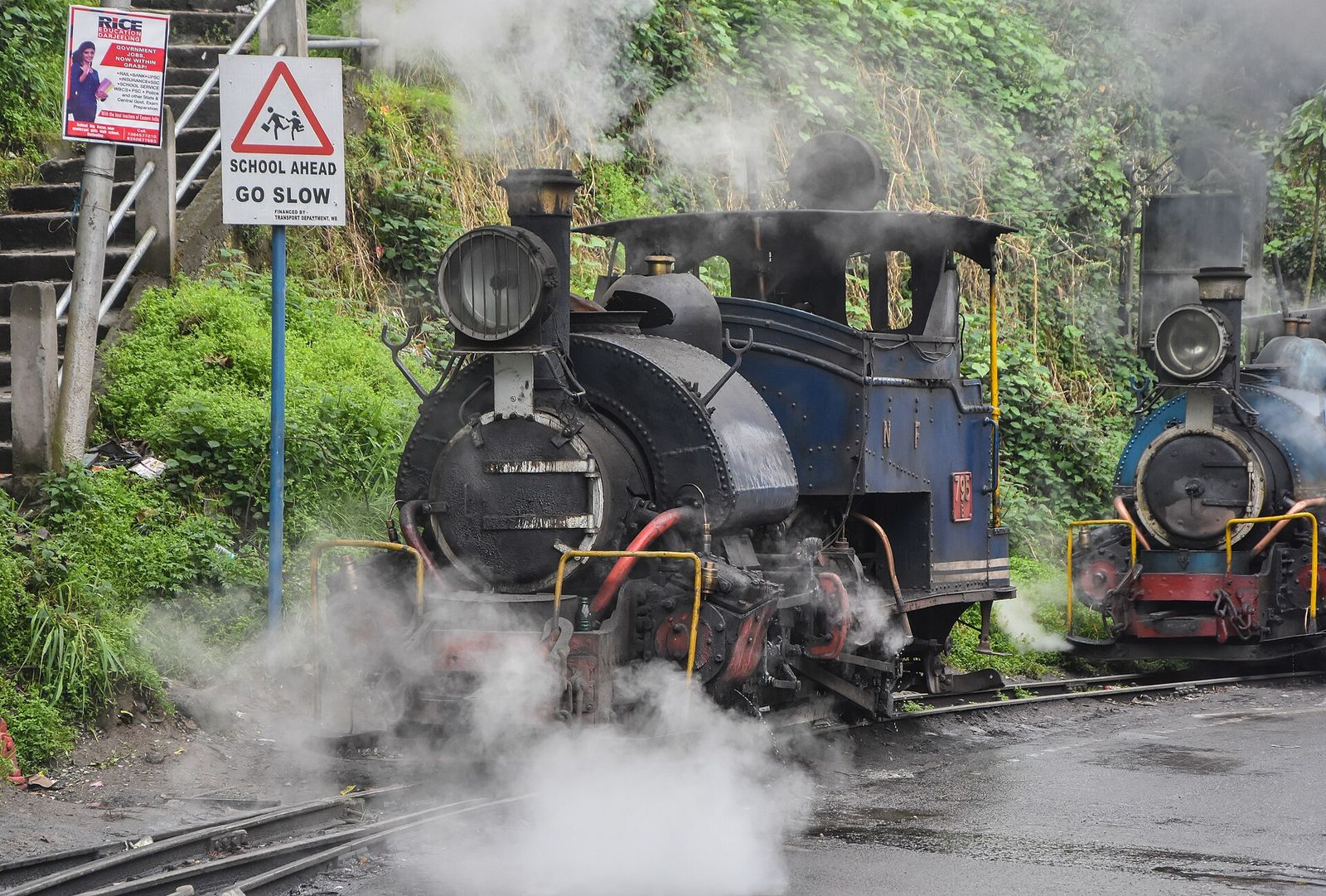
Slow trains, high hills: India's mountain railways
Three narrow-gauge lines, three UNESCO listings and one good reason to book the window seats.
There is a particular kind of travel that cannot be rushed, and India has three examples of it listed by UNESCO. The Darjeeling Himalayan Railway was inscribed in 1999, the Nilgiri Mountain Railway in 2005 and the Kalka–Shimla Railway in 2008, and in 2008 the three were brought together under the name Mountain Railways of India. All three were built in the nineteenth and early twentieth centuries to reach hill stations, and all three still do the job at the pace of a bicycle with a good tailwind.
The Darjeeling line runs on a two-foot gauge, among the narrowest in regular use. Its full route links Siliguri in the plains with Darjeeling, roughly 88 km away, climbing through tea gardens and forest and winding around the famous Batasia Loop. The Nilgiri line is shorter, about 46 km, from Mettupalayam to Udhagamandalam (Ooty), and uses a rack-and-pinion system on its steepest section. Kalka–Shimla, in the Himalayan foothills of Himachal Pradesh, is about 96 km long and passes through more than a hundred tunnels and hundreds of bridges; sources give different counts, so treat any single figure with care.
What suits two people is that the journey is the point. A narrow-gauge train in these hills is not fast, and the carriage is small enough that conversation is easy. You see the landscape change at the pace of a walk: tea terraces and mist on the Darjeeling line, eucalyptus and Nilgiri blue haze on the other, deodar and pine on the way to Shimla.
A few practical points matter more than any itinerary. Services change: parts of the Darjeeling line run as heritage steam or diesel excursions rather than as full end-to-end journeys, and landslides can interrupt any of these lines in the monsoon. Check current timetables and tourist services on the Indian Railways booking site and the relevant railway division before planning, and book early, because heritage services and the best coaches fill fast.
Pick one line and give it a base: two nights in Darjeeling, for instance, with the train as a half-day outing and the rest of your time for tea estates and walks; or Coonoor and Ooty on the Nilgiri line, with a day on foot in the tea country. Travelling in February keeps you clear of the monsoon and the summer rush, though mornings in the hills are cold and mist can hide views for days.
Think, too, about what the railways mean locally. Each is a working line as well as a heritage attraction, and it carries local passengers and goods. Be patient at stations, offer your seat, and buy tea or snacks from the vendors who depend on the traffic. And leave time at the end: a quiet afternoon after a long train ride is part of the trip, not wasted time.
Prices, dates, permits and rules change — approximate, verify before you travel. Researched from public sources; field verification pending.
Planning a journey like this?
Tell us the season and your pace — we'll shape it into a private itinerary.
Talk to a travel designer