
The Great Migration: following the herds without crowding them
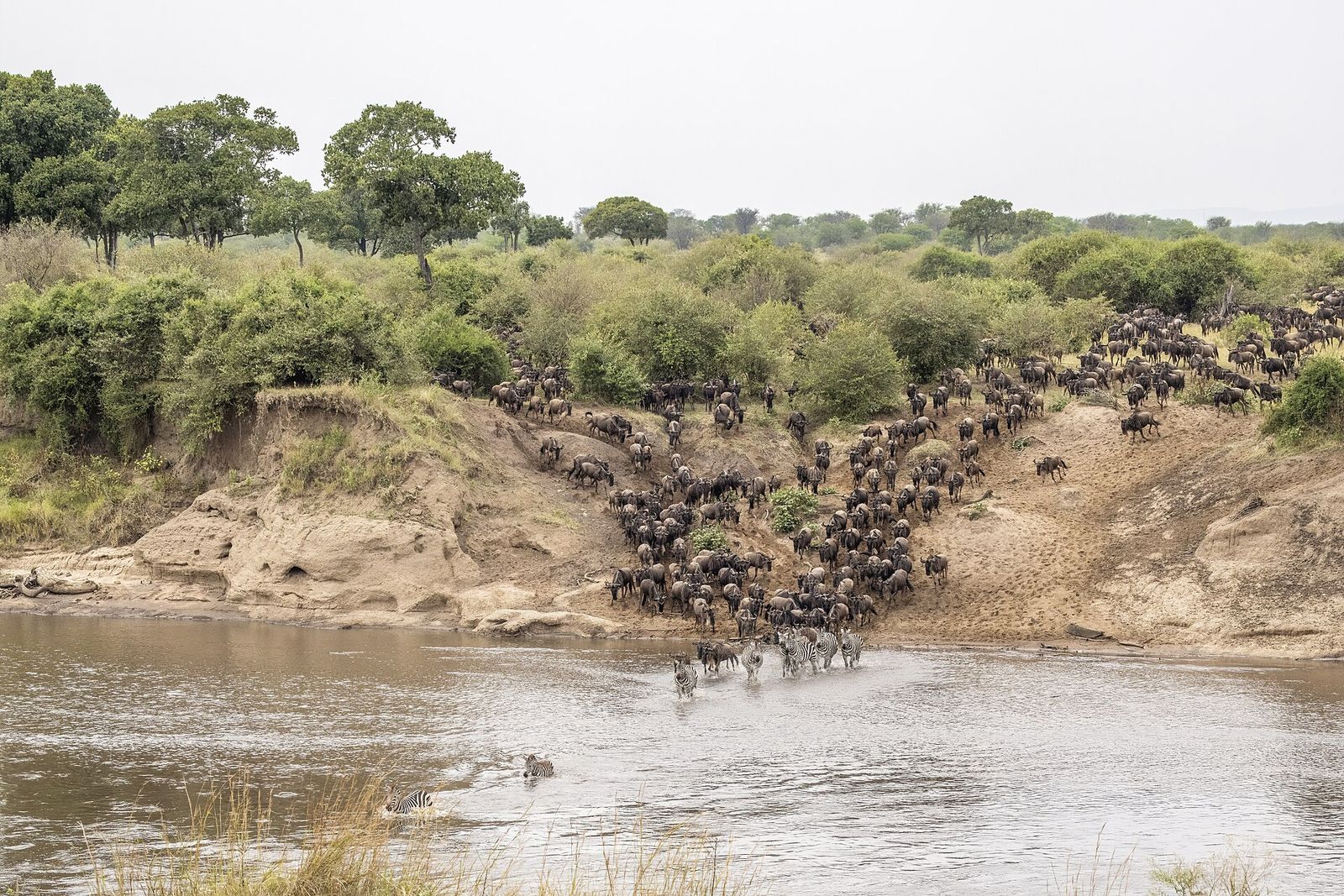
Every year, over a million wildebeest and zebra circle between Tanzania's Serengeti and Kenya's Maasai Mara. August is when many reach the Mara River.
The Great Migration is not one dramatic event but a year-long circuit. Herds of wildebeest, together with zebra and gazelle, travel a loop of roughly 600 kilometres through the Serengeti in Tanzania and the Maasai Mara in Kenya, driven by rain and the grass that follows it. Safari operators commonly put the numbers at around 1.5 million wildebeest and zebra; other estimates range from about 1.3 to 2.5 million, so treat any single figure as approximate.
The calendar, as operators describe it, runs like this. Calving peaks around February in the southern Serengeti. By July, herds begin reaching the northern Serengeti, and between roughly July and October the herds cross the Mara River, with August and September often described as the peak. By October, most animals are heading back into Tanzania. All of this shifts with the rains. If the rains are late, herds may linger in the Mara until late in October; if they are early, the best crossings can come and go before a visitor has arrived.
That uncertainty is the first thing to plan for. A river crossing cannot be scheduled. Herds gather on the bank, wait, turn back, and sometimes cross at dawn when nobody is there. A trip designed around one crossing is a gamble; a trip designed around several days in a rich ecosystem is not. Plan at least three nights in the Mara, and ask operators how they handle days when the herds are on the other side.
Crossings are also where behaviour matters most. Vehicles that crowd a river bank can push the herd away from the crossing point and make it harder for the animals to cross, and the animals pay for that. Ask your operator, before you book, what their rules are: how many vehicles at one crossing, how close, whether engines are switched off, and whether drivers will give way. A good guide will describe these rules without being asked.
Who are the neighbours? The Mara is surrounded by community-owned conservancies, where Maasai landowners lease land for tourism and limit vehicle numbers. Staying in a conservancy, or at a camp that pays conservancy fees, puts money in local hands and tends to mean fewer vehicles at each sighting. Another Kenyan ecosystem, Amboseli, has a Maasai-owned ranch patrolled by a team of women rangers; their story is in this issue's People pages.
Entry rules to check: Kenya requires an Electronic Travel Authorisation for most foreign visitors, and the official fee schedule lists a standard authorisation at USD 30 from 1 January 2025; third-party sites charge more. Citizens of East African Community states are generally exempt. Tanzania has its own visa rules and park fees; check TANAPA and the Tanzanian immigration site.
How to go well: choose small, licensed operators; avoid anyone who promises a guaranteed crossing; stay in the vehicle at crossings and speak softly; and let the herd decide.
Prices, dates, permits and rules change — approximate, verify before you travel. Researched from public sources; field verification pending.
Planning a journey like this?
Tell us the season and your pace — we'll shape it into a private itinerary.
Talk to a travel designer